


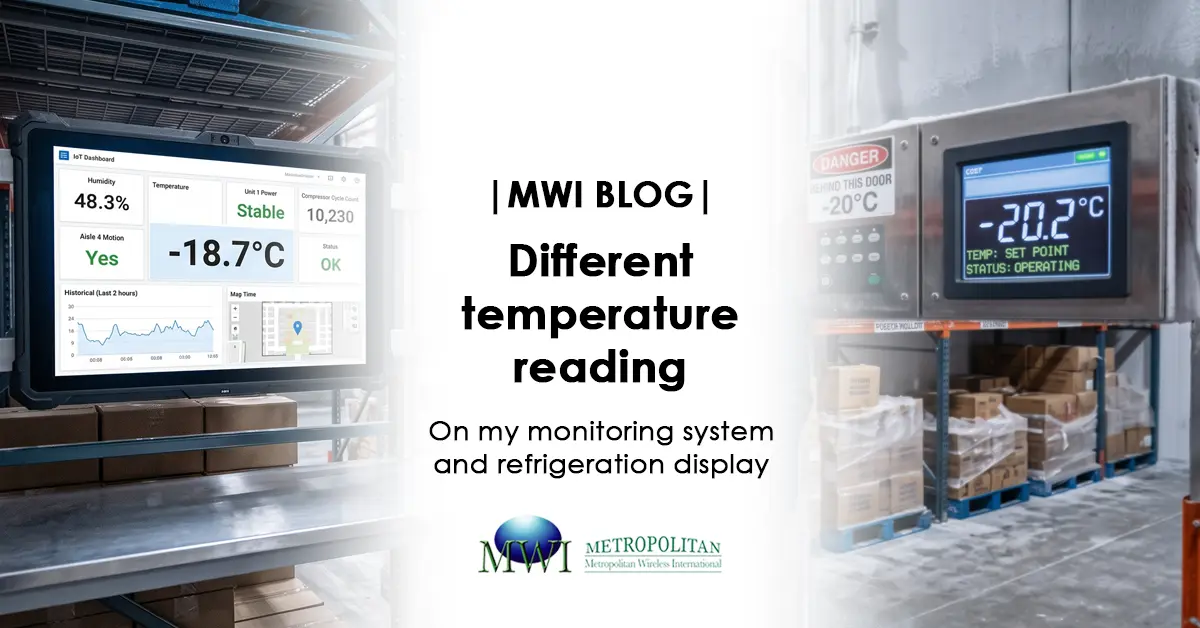
Have you ever looked at your freezer or chiller display and noticed that the temperature monitoring system (TMS) is showing a slightly different reading?
For example, the freezer display may show -20.2°C, while the temperature monitoring system reports -18.7°C.
The immediate reaction is often:
“Which one is correct?”
A difference between two temperature readings does not automatically mean that one of the systems is faulty.
In short, a temperature monitoring system and a freezer or chiller display may show different readings because their sensors can be installed in different locations and serve different purposes. Temperature variation, sensor accuracy, calibration and response time can also contribute to the difference.
In many cases, the two systems are simply measuring temperature at different locations, for different purposes, and under different operating conditions.
Understanding why this happens is important when monitoring temperature-sensitive products in cold rooms, freezers, chillers, laboratories, healthcare facilities, pharmaceutical storage areas and other temperature-controlled environments.
1. The equipment display and the temperature monitoring system have different purposes
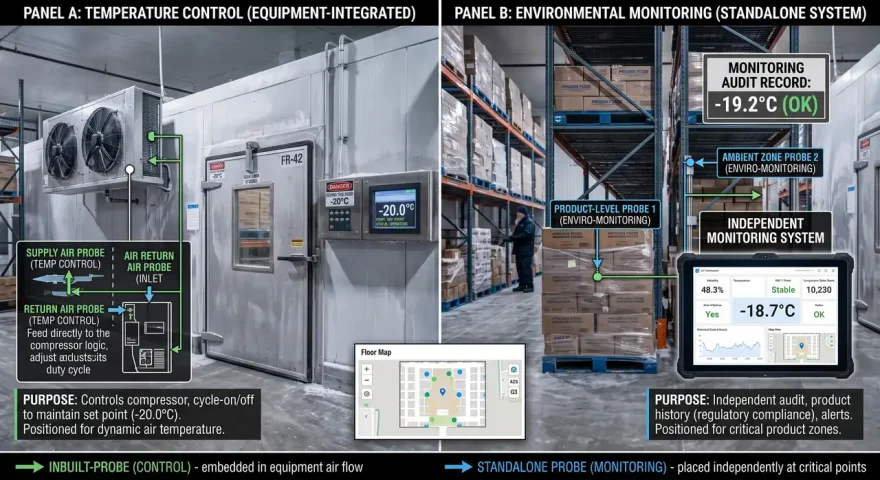
The first thing to understand is that the built-in temperature sensor of a freezer or chiller and an independent temperature monitoring system are not necessarily designed to perform the same job.
The refrigeration equipment’s sensor is typically part of the equipment’s control system.
Its measurement is used by the refrigeration controller to determine when cooling should start or stop, according to the equipment’s control logic and setpoint.
For example, refrigeration controllers can use a control sensor to determine when a compressor should switch on or off. Depending on the equipment design, the sensor may be positioned in the return-air stream, freezer compartment, or another location specified by the manufacturer. [1][2]
A temperature monitoring system, on the other hand, is normally installed as an independent monitoring system.
Its purpose is not to control the refrigeration equipment. Instead, it provides an independent measurement of the temperature at the location being monitored.
This distinction is important.
The question is therefore not always:
“Why doesn’t my TMS show exactly the same temperature as the freezer display?”
A better question is:
“Are both systems measuring temperature at the same location and for the same purpose?”
Often, the answer is no.
2. The two sensors may be in different locations
One of the most common reasons for different readings is simply sensor placement.
A freezer or chiller is not necessarily at one uniform temperature throughout its entire internal space.
There can be temperature differences between:
- the front and back of the unit
- the top, middle and bottom
- areas close to the evaporator
- areas close to air outlets
- areas near the return-air path
- areas close to the door
- areas surrounded by stored products
- areas with stronger or weaker airflow
WHO temperature-mapping guidance demonstrates this principle by using multiple sensors at different locations and heights within cold-chain equipment and storage areas. The purpose of temperature mapping is specifically to identify temperature variation throughout a three-dimensional space. [3]
This means that two properly functioning sensors can produce different readings simply because they are located in different parts of the equipment.
A simple example
Imagine a freezer where:
- the equipment’s control sensor is measuring air in one part of the freezer
- the TMS sensor is positioned closer to the stored products
The two sensors may not see exactly the same temperature at exactly the same time.
This does not necessarily indicate a sensor failure.
It may simply reflect the actual temperature conditions at those two locations.
3. Temperature inside a freezer or chiller is not always uniform
It is tempting to think of a freezer or chiller as having one temperature.
In reality, temperature can vary throughout the storage space.
Air movement, refrigeration cycles, loading conditions, door openings, defrost cycles and the location of cooling components can all affect temperature distribution.
For example, when a compressor or cooling system is operating, colder air may be circulating through certain areas. When the cooling cycle stops, temperatures can gradually equalise.
Opening the door can introduce warmer air.
Adding a large quantity of products can also change the thermal conditions inside the equipment.
This is why temperature mapping is used in many temperature-sensitive applications. WHO describes temperature mapping as the process of recording and mapping temperatures within three-dimensional spaces such as cold rooms, freezer rooms, refrigerators and freezers. [3]
The important point is:
A temperature reading represents the temperature at the location of the sensor — not necessarily the temperature everywhere inside the equipment.
4. The equipment’s sensor may be positioned for refrigeration control
Another important consideration is that the equipment manufacturer may position its sensor according to the requirements of the refrigeration control system.
For example, Danfoss documentation describes refrigeration control sensors being positioned in locations such as return air, depending on the type and design of the equipment. The measured value is then used by the controller as part of its temperature regulation function. [1][2]
This makes sense from an engineering perspective.
The refrigeration system needs a measurement that allows it to operate its cooling cycle correctly.
That does not necessarily mean the sensor location is the ideal location for independently monitoring the temperature of the products being stored.
This is one reason an independent monitoring sensor can provide useful information that is different from the equipment’s own display.
5. Sensor accuracy and calibration can also create a difference
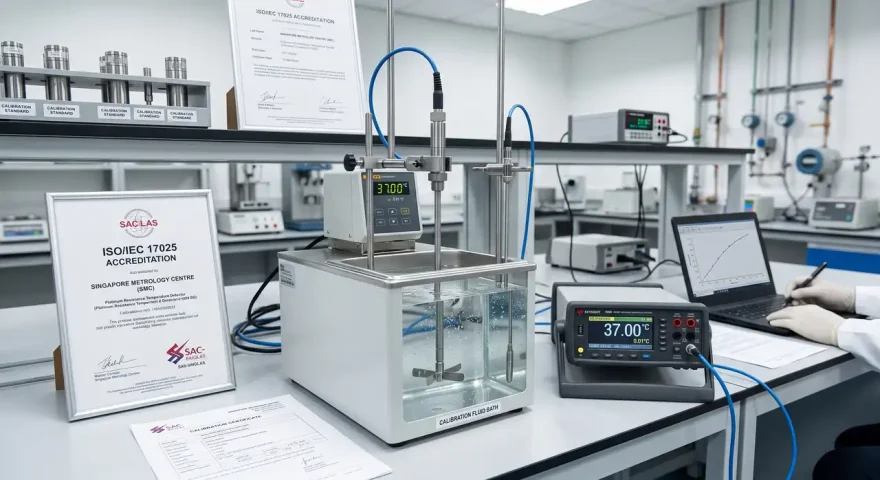
Even when two sensors are placed next to each other, their readings may not be identical.
Every temperature sensor and monitoring device has a specified measurement accuracy or uncertainty.
Calibration also matters.
Over time, measurement devices can experience changes in accuracy, commonly referred to as sensor drift. For applications where temperature accuracy is important, monitoring devices should therefore be properly calibrated and maintained according to the applicable requirements and manufacturer’s recommendations. [4]
For example, suppose two sensors are measuring the same environment:
- Sensor A: -18.0°C
- Sensor B: -17.6°C
A difference of 0.4°C does not automatically mean that one sensor is defective.
The accuracy specification, calibration status, sensor type, installation and measurement conditions all need to be considered.
For regulated or temperature-sensitive applications, it is therefore important to look at the measurement performance and calibration status of the device, rather than simply comparing two numbers on two displays.
6. Sensors may also respond differently to temperature changes
Another factor is response time.
Different sensors and monitoring devices can respond to changes in temperature at different speeds.
This becomes particularly noticeable when conditions are changing quickly.
For example, imagine someone opens a freezer door.
The air temperature around one sensor may change rapidly, while another sensor may respond more slowly because it is:
- located further away from the door
- surrounded by stored products
- enclosed or protected
- using a buffered probe
- designed with different thermal characteristics
The two devices may therefore show different readings during the temperature change, even if they eventually move closer together once conditions stabilise.
The same principle applies during compressor cycling, defrost cycles, loading and temperature recovery.
This is also why looking at temperature trends over time can sometimes provide more useful information than comparing two instantaneous readings.
7. Why might the equipment setpoint be different from the desired storage temperature?
Another source of confusion is the relationship between the refrigeration system’s setpoint and the desired temperature of the stored products or environment.
These are not necessarily the same thing.
A refrigeration controller may use a setpoint and a temperature differential or hysteresis as part of its control strategy. Danfoss, for example, describes refrigeration controllers using a control sensor, setpoint and differential as part of the cooling cycle. [2]
In some installations, the control temperature may therefore be configured differently from the temperature that the operator ultimately wants to achieve in the storage environment.
For example, an operator may want the storage environment to remain around 4°C, while the refrigeration system’s control settings may be configured below that value.
However, this does not mean that every system should be set to 2°C to achieve 4°C.
The correct settings depend on the equipment design, sensor location, control logic, temperature differential, airflow, thermal characteristics and operating requirements.
The important lesson is simply that:
The refrigeration control setpoint is not necessarily the same thing as the actual temperature experienced by products throughout the storage space.
So, which temperature reading is correct?
This is where the question becomes more complicated.
Instead of assuming that one reading must be correct and the other must be wrong, first determine what each sensor is actually measuring.
Consider the following:
1. Where is each sensor located?
Are the two sensors installed in exactly the same position?
If not, some temperature difference may be expected.
2. What is the purpose of each sensor?
Is one sensor being used to control the refrigeration system while the other is being used for independent monitoring?
If so, they may have been intentionally installed in different locations.
3. Are the sensors properly calibrated?
Check the calibration status and accuracy specifications of the monitoring devices.
4. Are the readings consistently different?
A stable difference may be very different from a sudden or increasing difference.
For example:
Stable difference
- Freezer display: -18°C
- TMS: -17°C
- Difference remains approximately 1°C over time
This may warrant investigation, but the difference itself does not prove that either system is wrong.
Changing difference
- Freezer display: -18°C
- TMS: -17°C
- Later TMS changes to -14°C while the freezer display remains at -18°C
This deserves closer investigation.
5. What happens during temperature changes?
Compare the readings during:
- normal operation
- door openings
- compressor cycling
- defrost
- loading
- temperature recovery
Looking at the trend can provide much more information than comparing two readings at a single point in time.
What should you do if your TMS and equipment display show different temperatures?
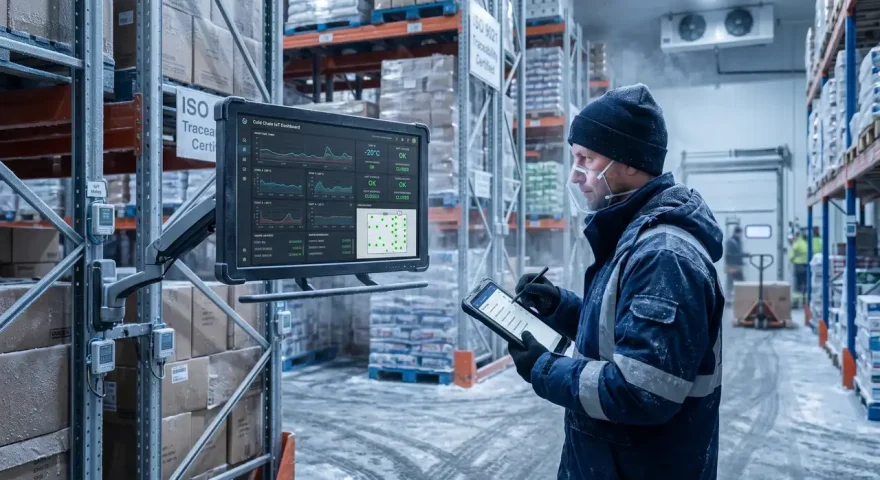
If you notice a difference, don’t immediately assume that the TMS is inaccurate.
Instead, work through a structured check:
Step 1: Check sensor locations
Confirm where the equipment sensor and TMS sensor are positioned.
Step 2: Understand the equipment’s control sensor
Check the equipment documentation to understand what the built-in sensor measures and how it is used by the refrigeration controller.
Step 3: Check the TMS sensor
Confirm that the TMS sensor is installed at the intended monitoring location and according to the system’s installation requirements.
Step 4: Check calibration
Verify that the monitoring device is within its required calibration period and that the applicable accuracy requirements are met.
Step 5: Compare trends
Don’t only compare the current temperature. Look at the temperature history and observe how both measurements behave over time.
Step 6: Consider temperature mapping
If the difference is significant or the application is critical, temperature mapping can help identify whether different areas of the storage environment experience different temperatures.
WHO’s temperature-mapping methodology uses multiple sensors at different locations precisely because temperature can vary within cold-chain equipment and storage areas. [3]
Step 7: Investigate unusual behaviour
A sudden, persistent or unexplained difference should be investigated further. Depending on the situation, this may involve checking sensor placement, calibration, equipment operation, airflow, door seals, loading conditions or the refrigeration system itself.
The purpose of a temperature monitoring system is not necessarily to reproduce the equipment display
This is perhaps the most important point.
A temperature monitoring system should not necessarily be judged by whether it produces exactly the same number as the refrigeration equipment’s built-in display.
The two systems may have different objectives.
The refrigeration system is designed to control the equipment.
An independent temperature monitoring system is designed to monitor the environment and provide visibility into temperature conditions.
When the monitoring sensor is positioned appropriately for the application, it can provide an independent measurement of the conditions at the location that matters.
This independence is particularly useful when temperature records are required for quality assurance, compliance, risk management or operational monitoring.
For example, the CDC recommends reliable temperature monitoring devices for vaccine storage and specifically recognises the importance of appropriate device placement, calibration and continuous temperature recording. [4]
The key question is therefore not:
“Why doesn’t my TMS match my freezer display?”
but rather:
“Are the temperatures being measured at the right locations, using suitable and properly maintained monitoring devices, for the purpose they are intended to serve?”
Conclusion
A temperature difference between a temperature monitoring system and a freezer or chiller display does not automatically mean that something is wrong.
The difference can result from several factors, including:
- different sensor locations
- temperature variation within the storage space
- different purposes of the sensors
- sensor accuracy and calibration
- sensor response time
- refrigeration control logic
- airflow and operating conditions
- door openings, loading and defrost cycles
In other words:
Two sensors can be working correctly and still show different temperatures.
The important thing is to understand what each sensor is measuring, where it is located, how accurate it is, and what purpose it serves.
For temperature-sensitive operations, the goal should not simply be to make two displays show the same number.
The goal is to have reliable, appropriately positioned and properly maintained temperature monitoring that gives you confidence in the conditions where your products are actually stored.
That is why understanding sensor placement and temperature distribution is just as important as choosing the monitoring technology itself.
Other Blogs
Food Storage
Medical Storage
IT Equipment
Server room temperature & humidity monitoring