


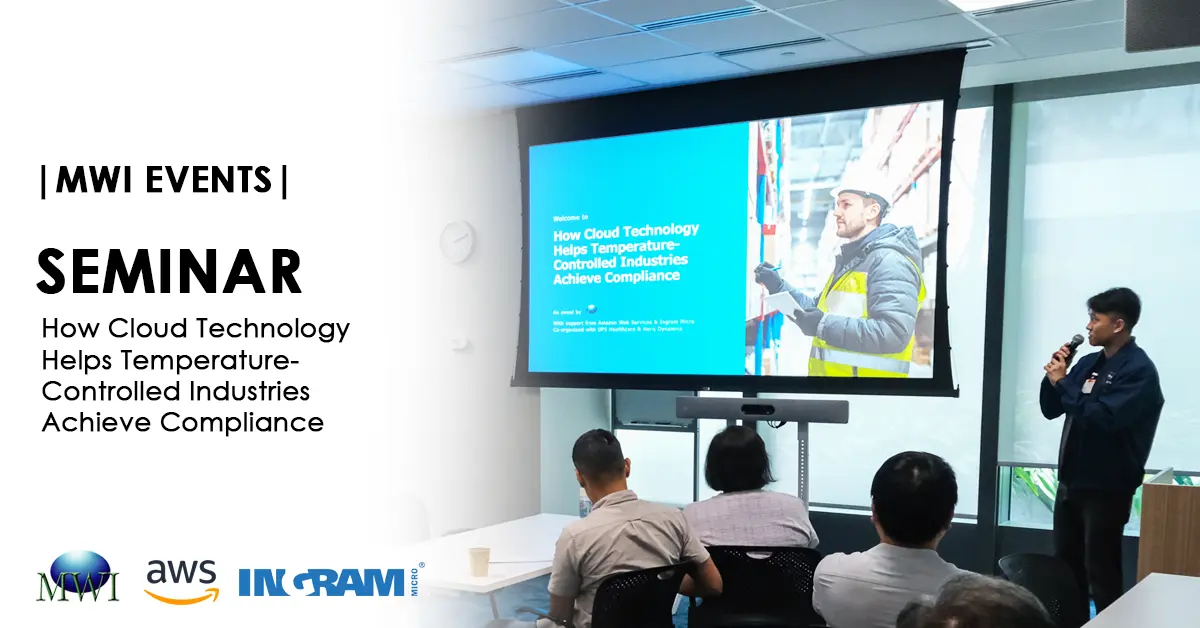
On 4 September 2026, Metropolitan Wireless International (MWI) brought together professionals from the healthcare, pharmaceutical, food, laboratory, logistics and technology sectors for an afternoon of knowledge-sharing, networking and discussion at the AWS Office at IOI Central Boulevard Towers, Singapore.
The seminar, “How Cloud Technology Helps Temperature-Controlled Industries Achieve Compliance,” explored an increasingly important question for businesses managing temperature-sensitive products and environments:
How can organisations use technology not only to meet compliance requirements, but also to improve operational visibility, reduce risk and make better decisions?
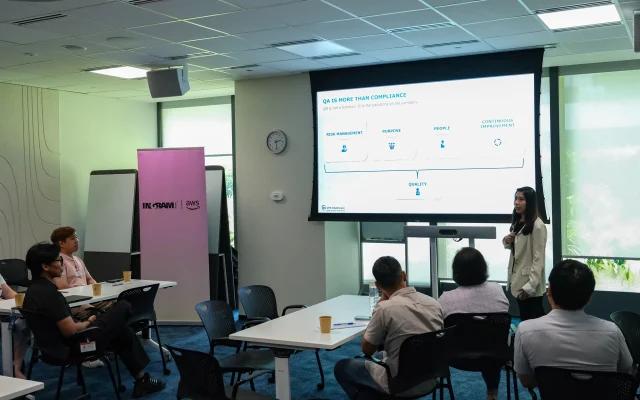
The event featured industry perspectives from MWI, AWS, Ingram Micro, UPS Healthcare and Aeris Dynamics, followed by an interactive roundtable discussion where participants shared their own experiences and challenges.
From Compliance Requirement to Business Necessity
Temperature monitoring has traditionally been viewed primarily as a compliance requirement.
Businesses need to maintain records, demonstrate that storage conditions remain within acceptable limits, and provide documentation during inspections or audits. In industries such as pharmaceuticals, healthcare and food, maintaining the right temperature can also be directly linked to product quality and safety.
However, the discussion highlighted that monitoring is increasingly becoming more than an exercise in record-keeping.
With cloud-connected monitoring systems, temperature data can be captured continuously, accessed remotely and converted into actionable information. Real-time alerts can also help teams respond to temperature deviations before they develop into larger operational or product-loss issues.
MWI’s temperature monitoring solutions, for example, combine wireless sensors, gateways and a cloud-based platform to provide real-time visibility, alerts and historical records.
The shift is therefore moving from:
“Can we produce the records required for an audit?”
to:
“Can we use our data to identify risks and take action before an incident becomes a problem?”
Who Should Own the Monitoring System?
One of the key roundtable discussions focused on an issue that is often overlooked:
Should the monitoring system belong to QA, Operations, Facilities or IT?
There is no simple answer.
QA teams may be responsible for compliance and documentation. Operations teams are often closest to the equipment and day-to-day processes. Facilities teams may manage refrigeration systems and building infrastructure, while IT teams are responsible for connectivity, cybersecurity and digital infrastructure.
This raises an important point: although a monitoring system may have a designated system owner, effective temperature monitoring often requires collaboration between multiple departments.
A well-designed monitoring process should therefore establish clear responsibilities for:
- Monitoring and reviewing temperature data
- Responding to alerts
- Investigating temperature excursions
- Maintaining sensors and equipment
- Managing user access
- Ensuring data integrity
- Preparing audit records
Cloud technology can provide a common source of data, but organisations still need clearly defined processes and responsibilities around that data.
When Two Temperature Readings Don’t Match
Another practical question generated significant discussion:
What happens when the temperature shown on a freezer display differs from the reading recorded by an independent monitoring system?
For example, the freezer display shows -18°C, while the monitoring system records -17°C.
Which reading should be trusted?
Rather than immediately assuming that one system is wrong, the discussion highlighted the importance of investigating the underlying causes.
Differences can arise from factors such as:
- Sensor location
- Sensor accuracy
- Calibration
- Air circulation within the storage environment
- Differences between equipment sensors and independent monitoring sensors
- Measurement intervals
- Sensor installation conditions
This is why simply having a temperature monitoring system is not enough. Organisations also need confidence in the accuracy, calibration and placement of their sensors.
For compliance-critical applications, MWI provides temperature monitoring systems with options for recognised calibration certificates through ISO/IEC 17025-accredited laboratories.
Can AI Replace IoT? A Question from the Roundtable
One of the more interesting questions raised during the roundtable was whether organisations could eventually do away with IoT monitoring altogether and rely on AI to predict or forecast temperature data.
It is an interesting proposition. If AI can analyse historical data and predict what temperature a freezer, cold room or other temperature-controlled environment is likely to reach, do we still need sensors collecting data in real time?
The answer is no.
AI and IoT should not be viewed as competing technologies. They serve fundamentally different purposes.
IoT provides the ground truth. AI amplifies its value.
IoT sensors continuously capture what is actually happening in the physical environment — the real temperature, humidity, power status or other conditions being monitored. This real-world data becomes the foundation upon which AI models can operate.
AI can then take that data further by identifying patterns, detecting anomalies, forecasting potential issues and helping organisations make more informed decisions.
Think of it this way:
IoT tells you what is happening.
AI helps you understand what it means and what might happen next.
For example, an IoT monitoring system may detect that a freezer’s temperature has gradually been increasing over several days. AI could analyse this historical pattern and identify it as an unusual trend, potentially indicating an equipment issue before the temperature reaches a critical threshold.
But without reliable real-world sensor data, an AI prediction is ultimately just a prediction.
For temperature-controlled industries where compliance, product safety and operational decisions depend on accurate conditions, the sensor remains the single source of truth.
The future is therefore unlikely to be IoT versus AI.
Instead, it is:
IoT → Data → AI → Insights → Action
IoT provides the foundation. AI builds intelligence on top of it.
The opportunity for businesses is not to replace one with the other, but to combine both technologies to move from simply monitoring conditions to understanding, predicting and proactively managing them.

Compliance Is Expanding Beyond Temperature
The discussion also moved beyond traditional temperature monitoring into another area that is becoming increasingly relevant to businesses:
Sustainability and carbon-emissions reporting.
As sustainability requirements and reporting expectations develop, businesses are facing additional questions about the cost and complexity of measuring and reporting emissions across their operations and supply chains.
For companies operating refrigeration, cold storage and logistics infrastructure, energy consumption can be particularly relevant.
This creates an interesting opportunity for organisations to think about monitoring more holistically.
Instead of monitoring temperature simply to ensure product safety, the same connected infrastructure can potentially provide visibility into other operational parameters such as:
- Energy consumption
- Equipment performance
- Power failures
- Humidity
- Door activity
- Environmental conditions
The broader question becomes:
How can businesses move from monitoring individual parameters to creating a more complete picture of operational performance?
Is Compliance a Cost or an Opportunity?
Perhaps the biggest takeaway from the roundtable was that compliance does not necessarily have to be viewed purely as a cost.
Compliance requirements can encourage organisations to examine processes that may have remained unchanged for years.
Replacing manual temperature checks with automated monitoring, for example, can reduce repetitive administrative work while providing continuous visibility. Automated reporting can also make it easier to retrieve historical records during audits.
More importantly, real-time monitoring can help organisations respond to problems earlier.
A temperature excursion discovered during the next manual check is fundamentally different from an excursion that triggers an alert immediately.
This is where the business value of cloud-connected monitoring begins to extend beyond compliance.
From Reactive Monitoring to Proactive Management
The evolution of temperature monitoring can be viewed in three stages:
Reactive → Real-Time → Predictive
Traditional manual monitoring is often reactive. An issue may only become apparent when someone checks the equipment.
Real-time IoT monitoring provides continuous visibility and alerts teams when conditions move outside defined thresholds.
The next step is using historical and real-time data to identify patterns and potential problems before an actual failure occurs.
This could include identifying unusual temperature trends, recurring equipment issues or changes in energy consumption.
The objective is no longer simply to record what happened.
It is to use data to understand what is happening, why it is happening and what might happen next.
More Than a Seminar
The discussions at the seminar reinforced an important point: there is no single technology solution that solves every compliance challenge.
Successful digital transformation requires the right combination of:
People + Processes + Technology + Data
Cloud technology and IoT can provide the infrastructure for continuous monitoring and data visibility, but organisations still need appropriate procedures, clear ownership and trained teams to turn that information into meaningful action.
For MWI, the seminar was an opportunity not only to share our experience in IoT and temperature monitoring, but also to listen to the challenges faced by organisations across different industries.
We would like to thank everyone who attended and contributed to the discussions, as well as AWS and Ingram Micro for supporting the event.
We would also like to extend our appreciation to our co-speakers from UPS Healthcare and Aeris Dynamics for sharing their knowledge and perspectives.
Most importantly, thank you to all the participants who brought their questions, experiences and ideas to the table.
The conversation around compliance, cloud technology and connected monitoring is only beginning.
The future of temperature-controlled operations isn’t simply about keeping things at the right temperature. It’s about having the right data, at the right time, to make the right decision.
Other Blogs
Food Storage
Medical Storage
IT Equipment
Server room temperature & humidity monitoring