



Heat stress is becoming an increasingly important workplace safety issue for Singapore’s construction industry.
For workers performing physically demanding activities outdoors, heat exposure is not simply a matter of being uncomfortable. High heat loads can affect workers’ health and ability to work safely, making heat stress an operational risk that construction companies need to actively manage.
Singapore’s Ministry of Manpower (MOM) requires workplaces to assess heat stress risks and implement an effective heat stress management programme for outdoor workers. The framework includes measures such as WBGT monitoring, hydration, rest and shade, acclimatisation and emergency response.
But having a WBGT meter is only one part of the equation.
The more important question for construction companies is:
How can site management know when heat-stress conditions are becoming a problem, and respond quickly enough to protect workers?
Heat stress is a changing site condition
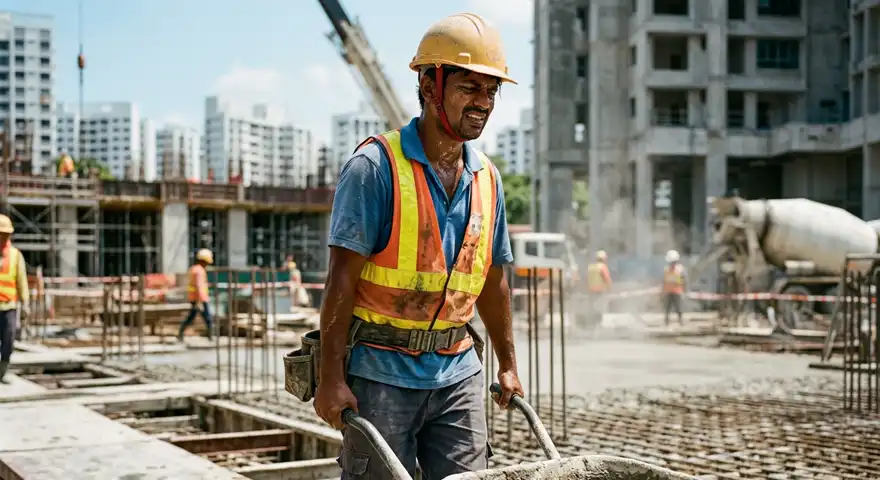
A construction site is not a controlled environment.
Conditions can change throughout the day as the sun moves, weather conditions change, wind conditions fluctuate and different areas of the site experience different levels of exposure.
Two work areas on the same construction site may also experience different conditions. A worker carrying out heavy physical work in direct sunlight may experience a very different heat load from someone working in a shaded area.
The risk can also depend on factors beyond the weather itself, including the intensity of the work, clothing, acclimatisation and individual worker factors. MOM notes that heat stress is influenced by environmental, task and worker factors, and that some workers may be more vulnerable because they are not acclimatised or have other personal risk factors.
This makes heat stress different from many other workplace risks.
A safety manager cannot simply look at the day’s forecast in the morning and assume that conditions will remain the same throughout the working day.
Heat stress risk changes with the environment and the work being performed.
That is why ongoing monitoring is important.
Temperature alone does not tell the whole story
One common way of thinking about hot-weather risk is simply to look at air temperature.
But air temperature alone does not fully describe the environmental conditions contributing to heat stress.
The Wet Bulb Globe Temperature (WBGT) is an internationally recognised measurement that reflects the main environmental factors contributing to heat stress. In addition to air temperature, WBGT takes into account factors including humidity, wind speed and solar radiation.
This is particularly relevant for construction sites because workers may be exposed to direct sunlight and physically demanding work for extended periods.
Instead of asking only:
“How hot is it today?”
site management needs to consider:
“What are the actual heat-stress conditions where our workers are working?”
That is where WBGT monitoring becomes useful.
Monitoring is only useful if it leads to action
The purpose of monitoring WBGT is not simply to produce a number on a screen.
The number needs to help site management make decisions.
MOM’s heat stress framework uses different WBGT bands to guide measures such as hydration, rest and shade, rescheduling outdoor physical work and other controls. For example, when WBGT reaches 32°C or above, a minimum hourly rest break of 10 minutes is required for heavy physical work. At 33°C and above, a minimum hourly rest break of 15 minutes applies for heavy physical work.
MOM’s WBGT monitoring guidelines specifically state that hourly monitoring is intended to determine heat-stress risk levels so that timely actions can be taken to protect workers.
This creates a simple operational chain:
Measure → Identify elevated conditions → Alert → Take action
The faster this chain works, the more useful the monitoring becomes.
A WBGT reading that nobody sees until much later has limited value when conditions are changing in real time.
Why real-time monitoring can make a difference
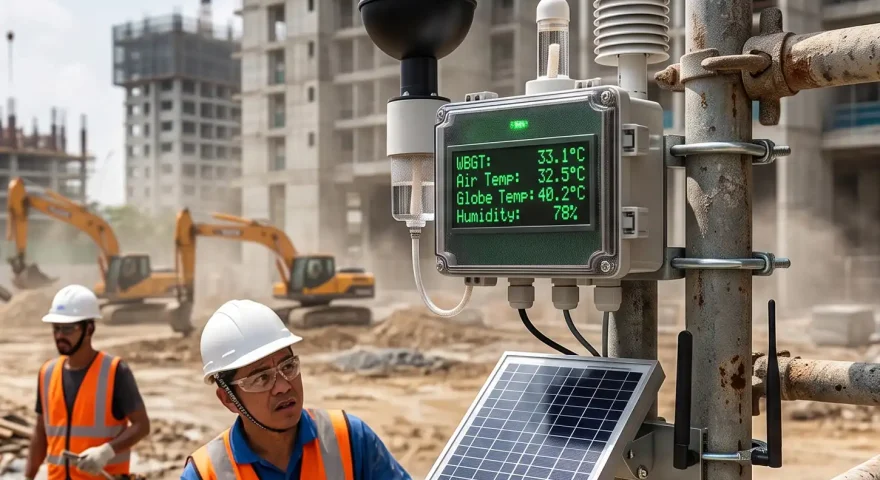
Traditional WBGT monitoring can involve a worker or safety personnel taking a reading from a meter at a particular location and recording the result.
This can work, but it relies on people being available to take measurements, interpret them and communicate the information to the people who need to act.
A connected monitoring system can change this process.
Instead of:
Go to the meter → Take a reading → Record the reading → Inform the relevant person
a connected system can provide:
Measure → Transmit → Monitor → Alert → Respond
This means site management can receive an alert when the WBGT reaches a predefined level, rather than relying entirely on someone noticing the reading manually.
The value of real-time monitoring is particularly relevant when conditions can change between scheduled checks. Instead of treating WBGT as a number that is simply recorded for compliance, the measurement can become an active input into day-to-day site management.
For a large construction site, this can also be useful where multiple work areas need to be monitored or where the people responsible for safety management are not physically standing beside the monitoring equipment at all times.
The value is not simply “IoT”
It is easy to describe a connected WBGT solution as an IoT system.
But the technology itself is not the important part.
The important part is what the technology enables the construction company to do.
A digital monitoring system can help turn an environmental measurement into an operational response:
1. Measure
The system measures the environmental conditions at the monitoring location.
2. Detect
The system identifies when the measured WBGT reaches a level that requires attention based on the site’s configured monitoring and response procedures.
3. Alert
Relevant personnel can be notified when conditions reach an alert level.
4. Respond
Site management can take appropriate measures, such as arranging rest, hydration, shade or changes to work activities.
This is where digitalisation can add value to conventional workplace monitoring.
The objective is not to collect more data for the sake of collecting data.
The objective is to help people respond to changing conditions sooner.
Why site-wide visibility matters
Construction sites can be large, complex and constantly changing.
A single reading may not always represent conditions across the entire site, particularly where there are significant differences in exposure between locations.
MOM advises that outdoor WBGT measurements should be taken at locations representative of heat-stress risk levels. It also recommends multiple monitoring points for larger workplaces.
This creates another potential advantage for connected monitoring.
Instead of treating each WBGT meter as an isolated device, multiple monitoring points can potentially be brought together into a central monitoring environment.
For example:
Monitoring Point A
WBGT: Normal
Monitoring Point B
WBGT: Elevated
Monitoring Point C
WBGT: High
Site management can then see where attention may be required without having to physically check every monitoring point individually.
For larger projects or organisations managing multiple sites, this type of centralised visibility can become increasingly useful.
Heat stress management is bigger than WBGT
It is important to remember that WBGT monitoring is one component of a broader heat stress management programme.
A monitoring system cannot replace appropriate workplace controls.
Construction companies still need to consider measures such as:
- worker acclimatisation
- adequate hydration
- rest and shaded areas
- appropriate work scheduling
- emergency response procedures
- monitoring vulnerable workers
- appropriate clothing and cooling measures
MOM’s framework requires employers and occupiers to implement measures to reduce heat stress risk, while its 2026 enhancements will introduce additional mandatory measures from 1 December 2026. These include heat-stress training for workers exposed to heat, cool drinking water near work areas, emergency cooling provisions, and suitable clothing to mitigate or protect against excessive heat stress.
MOM has also introduced a new recommended practice for shaded rest areas that are well ventilated and well insulated or cooled.
Technology therefore should not be viewed as a replacement for heat-stress management.
Instead, it can help make one important part of that management process more visible, timely and actionable.
From measuring conditions to managing risk
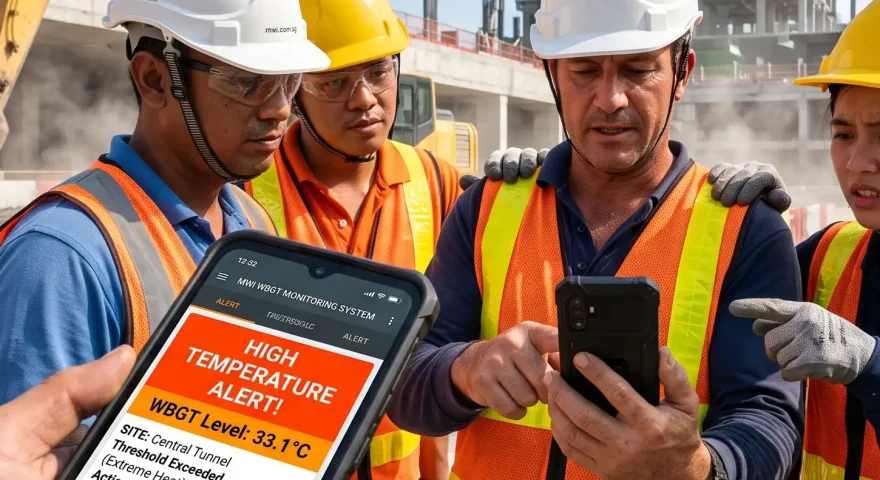
This is perhaps the most important distinction between having a WBGT meter and having a digital monitoring system.
A meter answers:
“What is the WBGT right now?”
A connected monitoring system can help answer:
“Is the WBGT becoming a concern, who needs to know, and how quickly can we respond?”
That difference becomes increasingly important as construction companies manage larger sites, multiple work areas and more structured workplace safety processes.
The goal is not to make heat-stress management more complicated.
It is to make the information required for decision-making available at the right time and to the right people.
Moving towards real-time heat-stress monitoring
As Singapore’s approach to workplace heat stress continues to evolve, construction companies have an opportunity to move beyond periodic manual measurements towards more connected forms of monitoring.
MOM itself has stated that it is working with companies to promote and trial technology solutions to better manage heat stress, including solutions that enable real-time, personalised monitoring of heat-illness risk in the construction and built-environment sectors.
For organisations that require greater visibility across their work areas, an IoT-enabled WBGT monitoring system can provide real-time readings, alerts and centralised visibility while reducing reliance on manual checking and communication.
MWI provides IoT-based monitoring solutions that combine environmental sensors, connectivity and cloud software to help organisations monitor conditions remotely and respond to changes in real time.
Learn more about our WBGT Monitoring System for Construction Sites in Singapore.
Final thought
Heat stress management is ultimately not about the number displayed on a WBGT meter.
It is about knowing when environmental conditions are becoming hazardous and giving people enough information to take appropriate action.
For construction companies, the next step in heat-stress management may therefore not simply be measuring WBGT, but making that measurement more timely, visible and actionable.
Sources
The article is primarily grounded in MOM’s own current sources:
- MOM — Heat Stress Measures for Outdoor Work
- MOM — FAQs on Heat Stress Measures for Outdoor Work
- MOM — Guidelines on WBGT Monitoring for Outdoor Work
- MOM — Enhancements to Heat Stress Framework, 28 August 2026
- MOM — Written Answer on Heat Stress Measures and Heat-related Productivity Losses, 6 May 2026
Other Blogs
Food Storage
Medical Storage
IT Equipment
Server room temperature & humidity monitoring